
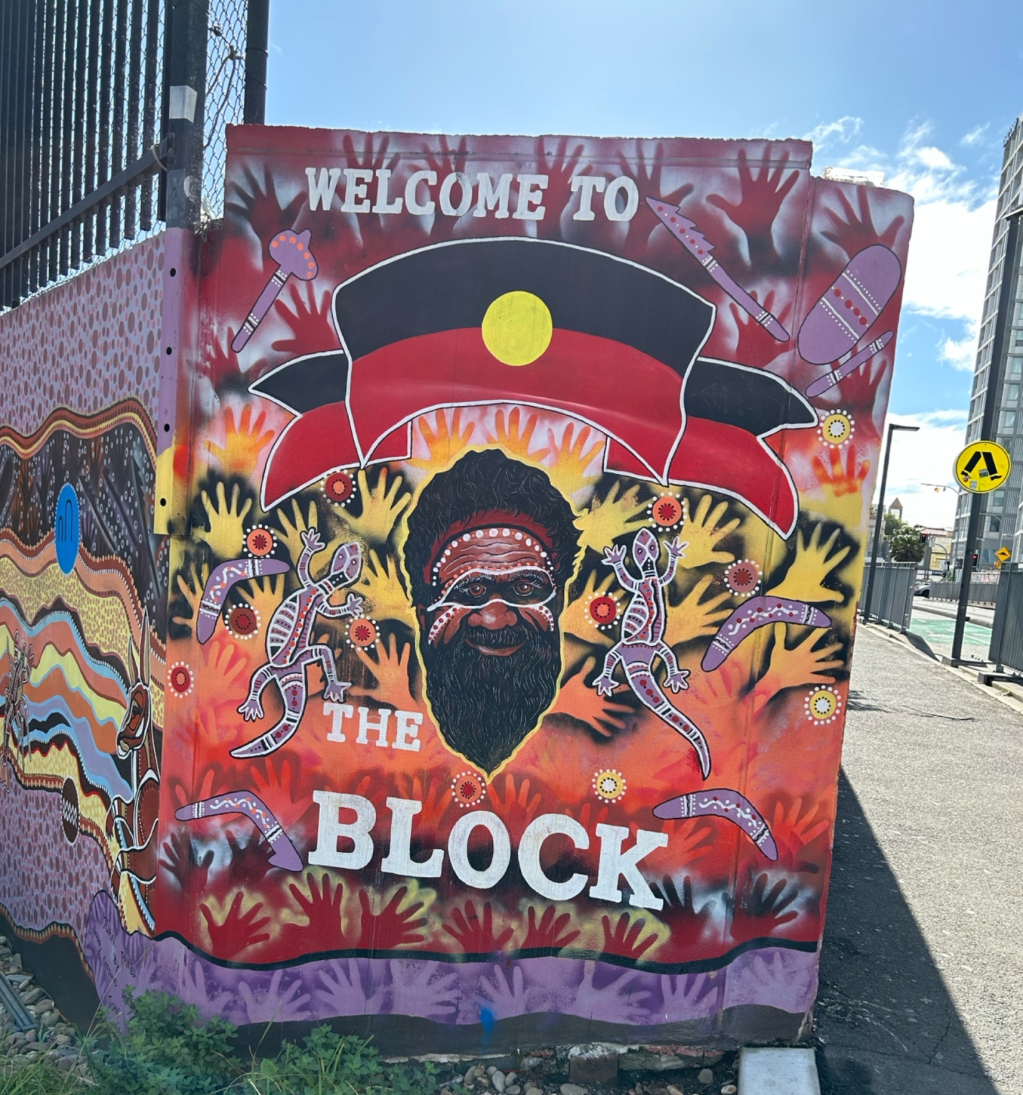
Drawing on the LFC framework and countermapping experiences in and around the university’s local community of Redfern-Waterloo, six key processes emerge as critical to understanding students’ learning journey in their countermapping experiences. These processes:
- form a scaffold that highlights the role of counter mapping, counter narratives and truth telling as pedagogical tools for transformative learning,
- explains how relational connections facilitate critical of understandings of place, space and atmospheres, reveals the role of history, power relations, systemic and racial inequities in education systems, and
- analyses the role of emotions and affect in engaging students and developing their critical consciousness.
In this process, highlighting the role of power and student emotional responses with truth telling and difficult knowledges became areas requiring further interrogation and therefore were added to the original LFC framework. The counter mapping pedagogical processes are described as follows:
- Country-centred, place-based connections where Country is recognised as a living entity and teacher. Student experience: Creating Country-centred relationships for me as a non-Indigenous educator is about getting out of my comfort zone and make the effort to reach out to Aboriginal community members and hear their knowledges.
- Making visible the hidden histories of colonisation. Student experience: It becomes a source of knowledge, and history, and… resistance against colonization… you’re redefining what the land is and how it’s used.
- Relationality reveals the emotional and relational connections to Country, Elders, and community members, describing a growing sense of belonging and responsibility. Student experience: Relationality invites us to conceptualise place through relationships rather than boundaries.
- Emotional engagement reveals rich and heart felt emotional responses and reflections – tears, discomfort, empathy, and transformation. Student experience: Once you’ve heard those stories, they’re now a part of your life… there’s a face to the community… a responsibility to do good with that.
- Critical conscientisation reveals the power of critical awareness of systemic injustices, colonial legacies, and personal positionality to rethink, reconfigure and reposition. Student experience: Critical engagement in LFC requires questioning the neutrality of ‘public’ spaces… Dominant maps are technologies of power that legitimise colonial occupation.
- Reparative action reveals intentions to mobilise change in their future classrooms and communities. Student experience: Engaging with members of the Redfern community, who exemplify Blak Excellence and high standards, provided a powerful narrative of resilience and achievement. Their experiences in education, particularly the impact of supportive teachers, highlighted the critical role educators play in shaping students’ futures. Inspired by these stories, I will strive to set high expectations for all my students, recognizing and nurturing their unique strengths.
 Learning from Country in the City